Mother Facing Cultural Upheaval
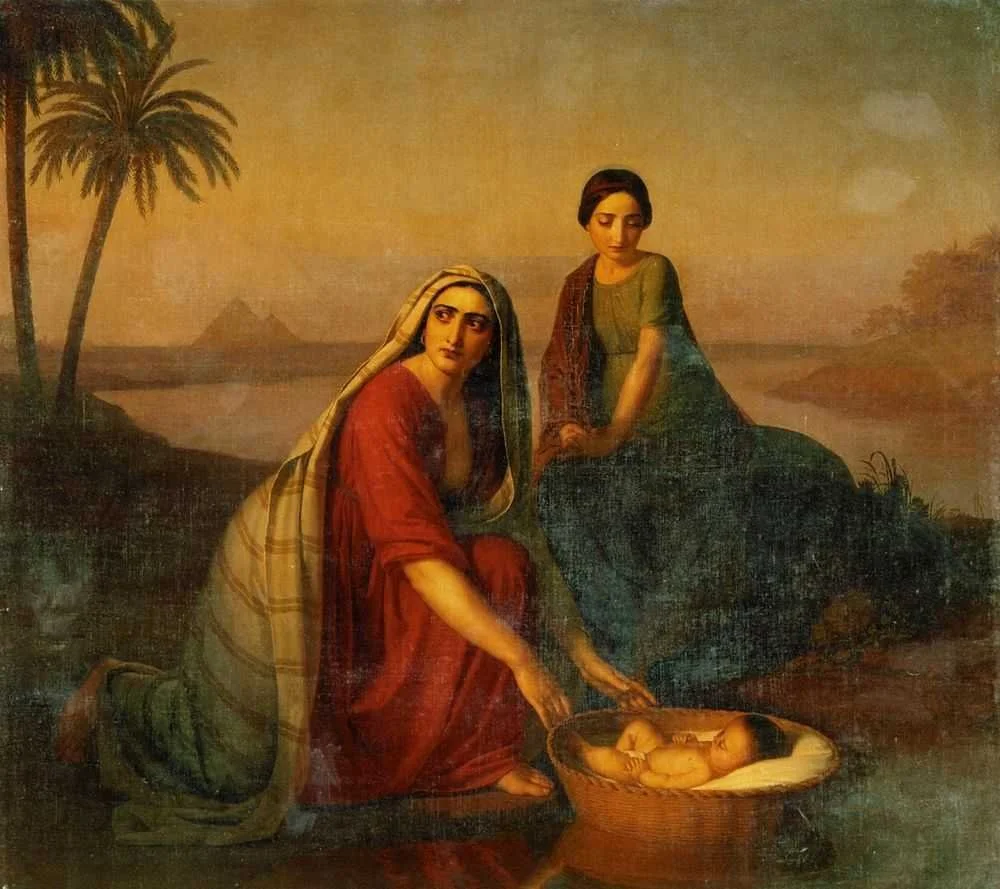
Alexey Tyranov, Moses' mother
Jochebed, Mother of Moses
Mama bears will do anything to protect their cubs—and mothers of all nations have this same innate strength. But in times of cultural and political strife, and war, or genocide, the heartbreaking decision to provide a better life elsewhere for your child sometimes means having to say goodbye.
Who was Jochebed? Having given birth to a son at a time when the Pharaoh was threatening to have all male Hebrew babies killed, Jochebed hid her baby for three months. And when she could no longer hide him, “…she took for an ark of bulrushes, and daubed it with slime and with pitch, and put the child therein; and she laid it in the flags by the river’s brink.” - (Exodus 2:1-4), which we envision as laying Moses in a waterproofed basket among the reeds. (“By faith Moses, when he was born, was hid three months of his parents, because they saw he was a proper child; and they were not afraid of the king’s commandment.”- Hebrews 11:23) He was discovered there by a royal maidservant and brought to the Pharaoh’s daughter. Jochebed’s daughter, Miriam, witnessed this and convinced the Pharaoh’s daughter to allow a Hebrew woman to nurse the child. That woman was Jochebed. Having nursed him and raised him, Jochebed brought her son back to the Pharaoh’s daughter to insure that he would be safe. God would eventually use Moses to lead the Hebrews out of slavery.
Modern women can draw several powerful lessons from the life of Jochebed, Mother of Moses, particularly regarding faith, sacrifice, and courage in the face of cultural opposition, modeling how to navigate impossible circumstances.
Faith Over Fear
Living under Pharaoh's death decree, Jochebed chose to fear God rather than man. For modern women, this translates into resisting cultural pressures or "diabolical decrees" that threaten their families or values.
2. The Power of Early Influence
Jochebed had only a few years to nurse Moses, yet she used that window to instill a deep sense of his Hebrew identity and faith in God. This reminds modern parents that their early, private ministry at home can shape a child's entire future mission.
3. Courageous Surrender
Placing Moses in the ark was an act of "active surrender" rather than abandonment. Modern women learn that trusting God often requires the difficult step of releasing their children—and their own plans—into His sovereign care.
4. Resourcefulness and Action
Jochebed didn't just wait for a miracle; she used the simple resources she had—papyrus, tar, and pitch—to create a plan of protection. She balances human responsibility with divine providence.
5. Seeing Potential in the "Unlikely"
Jochebed saw that Moses was "no ordinary child," recognizing divine purpose even when the surrounding culture deemed him a threat. This encourages women to advocate for the value and potential of life even in dark times.